Noah Smith wrote about his weight loss journey, and came to an interesting conclusion: that for him, the issue was noticing whether or not he was full:
I started paying attention to how much I ate. If it was “time to eat”, but I wasn’t hungry, I wouldn’t eat anything. And when I did eat, as soon as I felt like I wasn’t hungry anymore, I would stop eating. …
I realized, as I was doing it, that the difference between losing weight and not losing weight was just attention.
When I didn’t pay attention, I didn’t lose weight, because I kept eating after the point where I was no longer hungry. When I paid attention, I was able to control when I stopped eating.
He goes on to say that willpower is a conceit (my word, not his), and that the typical approach—”you have to be tough enough to fight through constant hunger, and motivated enough to want weight loss even more than food”—is wrong.
I fundamentally agree with the first part of Smith’s argument: attention is important. My weight loss this year has been predicated entirely on knowing how much I’m eating (along multiple vectors) and stopping myself from eating too much. My daily food spreadsheet was a key part of my success.
But I disagree with the hand-waving about willpower. People who are overweight have been told for their entire lives to stop eating when they’re full, slow down between courses, wait twenty minutes before taking seconds, and so forth. Knowing that generally doesn’t do much, because a person needs the willpower to acknowledge and recognize those guardrails.
When it comes to weight loss, as with any aspect of personal well-being, motivation is attention’s partner. Last winter, I was scared and desperate; that gave me the motivation to create the spreadsheet, and the willpower to pay attention to everything I ate every day for five months to reach David-minus-forty. I don’t know that I succeed with just one of those factors. And I’d guess that’s true for most people trying to lose weight.
I’m happy for Noah Smith and his successful and relatively low-key strategy. Whatever works for you! Achieving a healthy weight goal is a win, regardless of the path one takes to get there.
I bought my family an SUV in early 2023, and it was the first time in my life that I owned a car that was more than fifteen feet long. While spacious inside, at 186″ in length ours is still considered relatively small by modern SUV standards.
Truthfully, those modern standards are totally out of whack with how big our personal vehicles should and need to be. All that mass results in lower fuel economy, faster tire degradation and more wear-and-tear on our already strained roads.
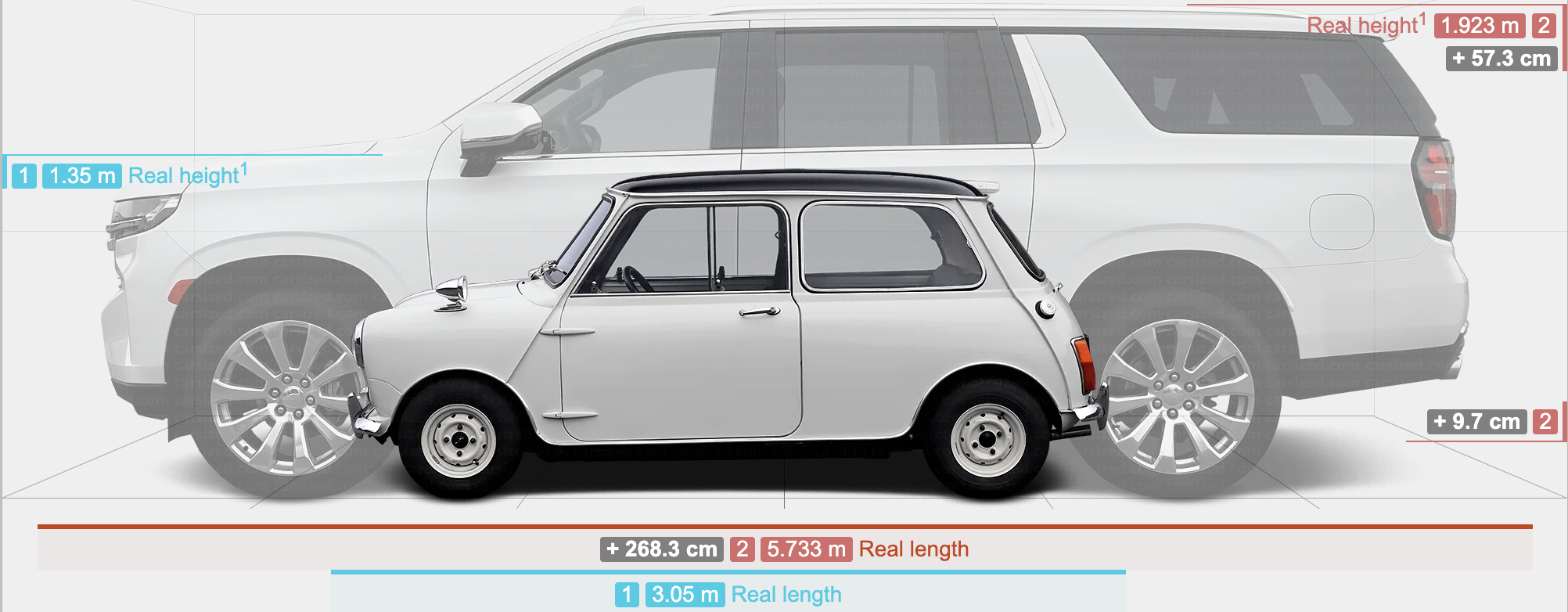
A friend bought a GMC Yukon XL that makes him laugh with glee at its ridiculousness. At 225.2″ in length, it is a more than three and a half feet longer than any of the cars I owned prior to 2023. It’s subtantially taller and wider, too.
Here’s an example of how much things have changed. In high school, our friend Frank’s dad had a brand-new, loaded 1991 Toyota Land Cruiser. It was huge! When he drove it to school we all wanted to check it out. We called it the Frank Tank.
That huge, show-stopping Frank Tank (188.2″ long, 72″ wide) is slightly smaller than a run-of-the-mill 2025 Hyundai Santa Fe (190.2″ and 74.8″).
A mobile phone battery lasts a couple of days on a charge, at best.
The battery in a car key fob expires after about a year.
Leave AA batteries in a remote for more than four or five years and they corrode and stop working. Sometimes they ruin the entire device.
Smoke- and carbon monoxide detectors have a 10-year lifespan; then their batteries (and detectors) become unreliable and need to be thrown away.
Meanwhile, the Thinner brand digital scale that we got in 2003 is still chugging away, and is 100% accurate to more than 200 pounds, on its original battery.
Kudos to the team behind this scale, which really was built to last.
My 13-year-old son has been playing clarinet since fourth grade: first on a lark with friends, then more seriously, as he joined the middle school orchestra. In recent months, he really began to enjoy it, and he’s playing a lot—sometimes for two hours at a time, sometimes as late as 10 p.m. before bed.
His bedroom shares a wall with our neighbors, an older husband and wife who we don’t speak to all that much. So I was surprised when the wife stopped me on the building’s front steps a few weeks ago, as I was returning from a dog walk and she was on her way out.
“Is your son playing an instrument?” she asked. “Like a woodwind, maybe an oboe?”
In my head, I cringed, ready for a complaint. “Yes, that’s our younger son. It’s a clarinet.”
For the past few years, I have lived around the corner from the Firemen’s Memorial in Manhattan. Every September 11, the neighborhood gets quiet. Streets are closed to traffic, and instead are filled with fire fighters in their formal uniforms, somberly marching to the monument, alongside a substantial police presence, mostly directing traffic but also respecting the moment.
I have no direct connection to the firefighters; I’m just a neighbor, and a lot of the time I’m walking my dog nearby. But since 2019, I have felt the moment more viscerally than I did for the decade-plus before, reminded of the effort, the tragedy, the grieving that continues.
Regardless, I don’t tend to dwell on the day, other than to pay my respects. Since it’s getting a fair amount of attention this year in other spaces, I thought I’d briefly call attention to how 9/11 was experienced here. My thoughts are with those who have much worse to remember today.
The Flatiron Will Go Condo. This is sad, because it will severely limit who can enter one of New York’s true landmarks. I had a job interview with Penguin many years ago, and HR was in the pointy end, and I can still picture the goofy narrow office in my mind. It’s a fun memory even today. Sixty luxury apartments will reduce opportunities like that to near-zero.
The point here isn’t to argue against capitalism, or to debate the merits of adding housing stock to a city that needs plenty, or to say my little recollection is particularly important. It’s about the Flatiron Building and New York itself, and what it means when landmarks turn into residential real estate.
Of course the Flatiron needs new life, and it’s a mess inside, and it’s such a major project that no one even wanted to buy the building. Commercial office space is not a bullish investment in 2024, and adding apartments in Manhattan is fundamentally good.
That said, its sixty ultra-high-end luxury condominiums are likely to be purchased by a mix of LLCs and holding companies, held as investment properties and pied-a-terres, ultimately contributing little to the neighborhood. A small staff will stand guard at a lobby that a limited number of residents will use each day. Is this the best outcome for the city?
The Plaza Hotel went condo in 2005, four years after the September 11 attacks, when New York was convinced that high-end hotels had passed their peak. This was widely viewed as a disappointment, one that spurred talk of government intervention. How soon we forget! No one wanted to lose access to such a grand, iconic space. Never mind that the old hotel was expensive; at least one could go there, see the lobby, get upstairs if interested, and experience it.
There’s still a hotel in the Plaza, of course, but greatly downscaled. What remains—some hotel rooms, the Palm Court, the ballrooms—exists in part because public pressure helped it persist. That pressure has abated. No one is really fussing over the Waldorf-Astoria’s slow transformation into a more residential space, other than to lament how long it’s taking. And few are going to fuss over the Flatiron, if the reactions to that Threads post are any indication.
I know firsthand what it means to have set foot in these iconic buildings, to use them for their stated purpose, and my hope is that many others get to experience them, too, not just as nice pieces of architecture (which they all are) but as part of the city’s fabric.
Just before the Plaza closed as a full hotel, my wife and I spent a night there. We wanted to experience its grandeur for ourselves. And it was grand indeed: wide hallways, high ceilings, a strikingly oversized room, and all the prewar detail still on the walls, aged but beautiful. Staying there was a singular New York experience. Like my one pop into the Flatiron Building, I’m glad I got to be there. So, too, my coffees in the lobby of the Waldorf, and the various industry dinners I once attended there.
There will always be somewhere else to go for a meeting, a dinner or a night’s stay, and landmark designation means these special buildings will remain a part of the streetscape. Still, losing access to them, in full or in part, marks a shift away from part of what makes them special.
For most of the first century of its life, the Flatiron was a thriving space, with thousands of people walking into its lobby and filling its 22 stories with an ever changing population, each generating their own experiences, their own memories. The building was lively inside and out. That is likely never to return. And the transition away from a bustling and interwoven piece of the city is noteworthy, and a little bit sad.
“I don’t have to like everything. But maybe I’m attracted to it because it’s unusual or makes me feel anxious or makes me want to dance or other kinds of impulses that get triggered.”
That’s drummer Doug Schulkind, in conversation with Rob Walker, discussing how he approaches music. It’s a great quote to keep in mind when flipping around radio stations or streaming music feeds. Or doing anything new in life, really.
Also, this:
“My end goal is to live long enough to have loved everything, and I’m not going to get there, but I’m getting there as fast as I can.”
Seriously: I love license plates. I think they’re endlessly interesting and amusing. Growing up, I played the license plate game for years on family vacations, looking for every U.S. state (Montana was my last). I got to know styles, variants, and updates for all of America, and the plates for eastern Canada, too. Growing up, I hated my local plates, so I tried to design my own (more on that later). I read—past and present tense—license plates as I go by, looking for catchy phrases and humor; I know by alphanumeric sequence which plates in my home state are the newest; I bristle at the new trend of defacing a plate to avoid tickets and tolls—in part on ethical grounds, and in part because it takes away some of my fun.
For better or worse, I have passed on this fixation to my younger son, who constantly tells me about what he sees, although he’s more about the logical order and less about finding words where there aren’t any. We do both enjoy a well done custom plate.
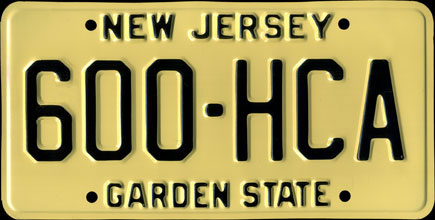
Anyway, Garrity’s post was about the recent history of PEI’s license plates, so let me discuss my own. I grew up in New Jersey, and when I was a little kid, they all looked like this:
New Jersey license plate, 1970s.
They weren’t much to look at, but they get high functional marks, with their high contrast making them easy to read. (I recall at one point learning about how plates’ readability correlates to cops’ ability to recover stolen cars.)
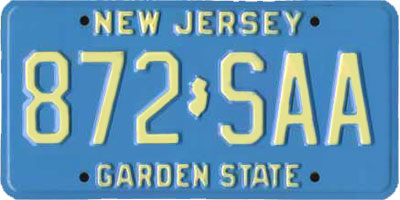
Soon after I started paying attenion, the Jersey plates got redesigned. The state added a New Jersey silhouette to the profile, replacing the center dot, but they inverted the color scheme, and came up with this cringe-worthy style:
New Jersey license plate, 1980s.
Apparently “blue and buff” is a thing to New Jersey, but it makes for an awful license plate. Readability certainly took a hit with this style. And the overall effect was just unattractive.
I had an Apple //c computer growing up, and around 1987 I went so far as to redesign the New Jersey license plate in Dazzle Draw. (Why I didn’t draw it freehand, I do not know.) I played up the Garden State angle, with a Jersey Tomato, and leveraged the Jersey Devil and the new hockey team’s color scheme, making a design with a white background and green-and-red visual elements. I sent two variations with a note to Governor Tom Kean’s office. I’m sure it looked pixelated and awful, but I bet it wasn’t any worse than the blue and buff license plate. The governor’s office did not respond.
By 1993, I had gotten a new car, and New Jersey had updated its license plates again, so mine looked like this:
New Jersey license plate, 1990s.
Readability was back, and the design was both retro and modern with its color fade, but what was this design? We’re giving up on “buff and blue”? The nice state stamp in between the letters stuck around, but in an era when other states’ license plates were increasingly attractive and clever, Jersey got a plate that met outsiders’ low expectations. With minor tweaks, this design persists to present day, thirty years of uninspired license plates on the Garden State Parkway.
Meanwhile, New York was pulling ahead. My childhood memories of New York plates were of the color and then the Statue of Liberty, which were fine—not exciting, but somehow more stately, interesting and important than New Jersey. Like the state and its namesake city, New York’s license plates (like California’s) had some presence, and it suited them.
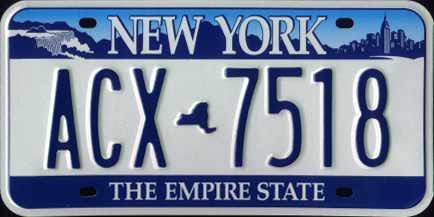
In 2001, New York redesigned its license plates to showcase more of the state, and they nailed it.
New York license plate, 2000s.
This plate brought lots of good elements together: the state outline divider, the slogan, and a collage of statewide geographic features across the top, from Niagara Falls to the Adirondacks to the Manhattan skyline. It was handsome, easy to read, interesting and memorable. A great license plate.
My car at the time was registered in New Jersey, so I missed having that license plate on my vehicle. By the time I got a new car, in 2015, New York had moved back to the orange-and-navy theme of the 1970s, ditching the geographic elements, which were beginning to seem fussy, in favor of a simple, clean layout.
New York license plate, 2010s.
This design was… fine. Easy to read, plays off the past, curved lines and fonts give it some style, the shade of orange matched the NYC taxicab fleet pretty well. I didn’t love it, but there was nothing to dislike, either.
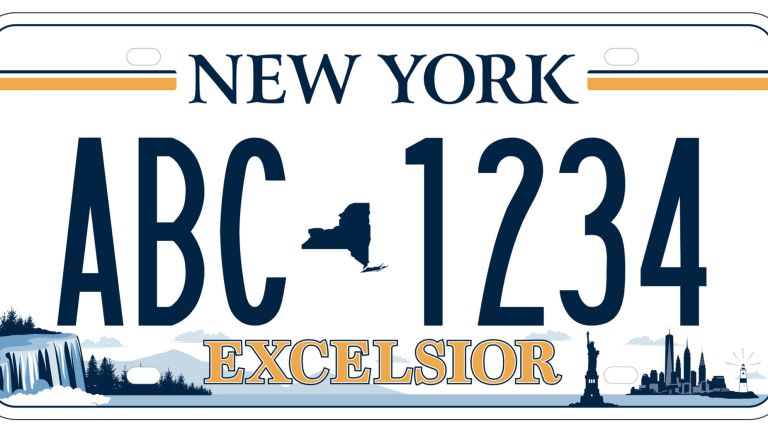
The same cannot be said of the current New York plates, which adorn my car now. They are emblematic of much of the Andrew Cuomo administration: well-intentioned, earnest, but failing to stick the landing.
New York license plate 2020s.
We are back to the previous geographic elements—all of them! Plus the Statue of Liberty returns, and now there’s a lighthouse, and some clouds. “Empire State” has been sacrificed for EXCELSIOR, which Cuomo loved to use, presented in an overly bold and blocky font, while the stripes atop the plate fall at an odd height and fail to tie the design together. The overall effect is amateurish. Kind of like something a middle school student would design at home, only this time it’s on every new license plate in the state.
Governor Kathy Hochul hasn’t expressed much concern over the current New York license plate, which is just three years old, but perhaps her successor will. Maybe we’ll get something inspired for the next decade. At least the current plates are easy to read. Excelsior.
A number of years ago, I made a conscious decision, based around privacy concerns and ad trackers, to minimize my time spent on Facebook and Instagram. It wasn’t especially hard; I deleted the Facebook app on my phone and diverted my attention elsewhere, and that was that. A little bit of righteous indignation goes a long way.
I have largely stuck to my decision and I’m no worse off for it. I’m not a Meta heathen; my accounts are active, and every now and again (a couple of times a month, I’d guess) I look through my feeds. I occasionally post to one or the other, when the moment is right. (And I use WhatsApp, because every group chat that’s not immediate friends now defaults to WhatsApp.)
Mostly, though, I’ve chosen to keep current on the news and chatter of the day, rather than the personal posts of social media. And for a long time, getting the best information of the moment meant hanging out on Twitter.
For the past nine months or so, the once-vibrant Twitter community has watched with concern as its new owner has put the service on a path of self-destruction. Competitors are now rushing to take its place, from grassroots distributed platforms to scrappy startups to, now, Instagram, in the form of Threads. Like many others, I have accounts on all of them.
Perhaps in a few months or years one of these systems will be our collective hangout like Twitter used to be. In the interim, though, it’s all rather overwhelming. I find myself completely at a loss as to which short-form posting platform to open. I’ve been flipping indiscriminately around all day without rhyme or reason. And still in muscle memory is that Twitter search is best for in-the-moment breaking news, so I’m still there, too, quieter but not gone.
What to do? We have so many decision points now. For one, where are my friends? My business colleagues? The interesting journalists and pundits I follow? The push news from the sources I trust? The fantasy baseball content? Darth?
Then: who do I want monetizing my feed? Elon Musk, on a site where he’s pushing extremist views? Or Mark Zuckerberg, whose platforms I so deliberately left not long ago? Or Jack Dorsey, whom most people blame for this situation existing at all? Or no one at all, via Mastodon, but leaving so much behind?
Or maybe—just maybe—I should just let go?
It may be time, at least for me, to stop chasing the conversation. It’s not really a conversation, anyway, not most of the time; you post, I post, they post, once in awhile someone replies, and once in a great while an actual conversation ensues. We’re all so used to this cadence that we don’t realize we don’t need it. But I know I don’t: my time away from FB/IG proves it. I just need to extend that motivation.
Giving up a 15 year short form posting habit would not be easy. I enjoy having an outlet for sharing thoughts in writing (see also) and with social media there’s a built-in audience. But then, audiences are elusive; sometimes my posts get some attention, and oh the dopamine hit that comes from a retweet, but sometimes I float a thought at the wrong time of day, or that the algorithm doesn’t dig, and fewer than 20 people even see it. With the fragmentation of the landscape, it’s all a crapshoot now.
I’ve been carrying around an old copy of “The Power Broker” for a good while. This could be a great time to commit myself to it. And a hundred other things that don’t require a social media feed.




.png)