I was delighted to be contacted by Manuel Moreale for his long-running People and Blogs interview series, which went live today. If you didn’t come here from there, here’s our conversation. The archives are full of interesting people and worth poking through. Thanks, Manuel!
Category: Personal (Page 1 of 26)
Noah Smith wrote about his weight loss journey, and came to an interesting conclusion: that for him, the issue was noticing whether or not he was full:
I started paying attention to how much I ate. If it was “time to eat”, but I wasn’t hungry, I wouldn’t eat anything. And when I did eat, as soon as I felt like I wasn’t hungry anymore, I would stop eating. …
I realized, as I was doing it, that the difference between losing weight and not losing weight was just attention.
When I didn’t pay attention, I didn’t lose weight, because I kept eating after the point where I was no longer hungry. When I paid attention, I was able to control when I stopped eating.
He goes on to say that willpower is a conceit (my word, not his), and that the typical approach—”you have to be tough enough to fight through constant hunger, and motivated enough to want weight loss even more than food”—is wrong.
I fundamentally agree with the first part of Smith’s argument: attention is important. My weight loss this year has been predicated entirely on knowing how much I’m eating (along multiple vectors) and stopping myself from eating too much. My daily food spreadsheet was a key part of my success.
But I disagree with the hand-waving about willpower. People who are overweight have been told for their entire lives to stop eating when they’re full, slow down between courses, wait twenty minutes before taking seconds, and so forth. Knowing that generally doesn’t do much, because a person needs the willpower to acknowledge and recognize those guardrails.
When it comes to weight loss, as with any aspect of personal well-being, motivation is attention’s partner. Last winter, I was scared and desperate; that gave me the motivation to create the spreadsheet, and the willpower to pay attention to everything I ate every day for five months to reach David-minus-forty. I don’t know that I succeed with just one of those factors. And I’d guess that’s true for most people trying to lose weight.
I’m happy for Noah Smith and his successful and relatively low-key strategy. Whatever works for you! Achieving a healthy weight goal is a win, regardless of the path one takes to get there.
I haven’t really been a paying member of anything since my college fraternity. (The gym does not count.) My wife and I find it mildly amusing that we live in Manhattan with children who play golf and tennis; if we were in the suburbs, it’s likely that we’d have joined a country club a long time ago. But that did not come to pass, and nothing clubby really came up.
Nothing, that is, until earlier this month, when friends of ours suggested we join their beach club for the season. With said children now in their teens and home for the summer, we furrowed our brows at the open dates in their schedules. Why not? Amy and I took a ride out on a rainy Sunday, picked a cabana, and joined the club.

Beach clubs still exist, plentifully, on the Long Beach barrier island, just east of the Rockaways on the south shore of Long Island. (I counted 21 of them on a quick flip through Google Maps.) We have visited a few of them over the years. They’re not quite The Flamingo Kid, but the spirit and general intention is still there.
Each one sticks to the formula: an expanse of beach with chairs and umbrellas; a restaurant; some games; a pool; scheduled events; no shortage of clichés (in our club’s case, there are cabana boys, a sports-desk attendee who doesn’t know what a ping pong ball is, and two charismatic blonde women who run the show). And, of course, cabanas.
The cabanas are the big selling point. Spacious and reasonably equipped with shelving, changing rooms, a shower and electrical power, they become home base for the summer. Ours is in a courtyard, like most cabanas at this club, but there are beachfront cabanas and smaller pool lockers, too. Regulars kit out their cabanas with signage and decor, like the one down the row from ours with string lights and a patio lounge chair, and the one around the corner from there with “Copa” permanently affixed above the door (Get it?).
We went for the first time Thursday—late for beach cabana season; it opens on Memorial Day—and again Saturday. The trip to the island takes us on the Van Wyck and its unique misery, but once there, having a cabana at a club is a delight. Our stuff is waiting for us! A cabana boy dropped off some ice! The restaurant is good! We spent time with friends both days and our new neighbors are friendly and welcoming. And, of course, there’s the beach, fully 300 feet deep even in this erosional era, with soft sand and the vast Atlantic Ocean beyond. Dolphins even surfaced in front of us at one point.
I took some time Saturday to run to Target and stock up the cabana. “You should sit and enjoy yourself,” Amy said to me. “But if I’m getting the cabana kitted out, I am enjoying myself,” I replied. So we now have sealed storage for our snacks and a new outdoor speaker, with a folding table and chairs on the way. The club is open seven days a week, and an oceanside twist on remote work is not far behind.
We’re still getting our seashore legs, but so far, this seems like a great way to while away the summer.
Because it’s really all I think about in my spare time lately, and I need to get it out of my system.
I’m still losing weight. I am way below the target I mentioned in this space last month. I did some homework, and realized that broader measurements of “ideal weight” and “healthy BMI” were less than my doctor’s goal for me. So I set my sights lower and lost another 11 pounds. I’d like to lose two more pounds from here and maintain from that point, although if this is as thin as I get, I’m great.
I saw my doctor last week and he was borderline giddy with my progress. He even thought I was on a GLP, which is probably the best compliment I’m going to get.
Plateauing has been satisfying. Last week I touched my all time low, and since then, I’ve let myself go, relatively speaking: looser on the calorie count, occasional sweets instead of never. That has been a delight. Still no French fries since December, though.
Fewer people than expected say anything to me about how thin I’ve gotten. Amy thinks it’s the Ozempic effect: you don’t know how or why someone is losing weight, especially after age 50, and a person could be embarrassed at taking the GLP-1, or unwell. So it’s not a topic to bring up lightly.
Honestly, I miss the before times, when I’d lose 10-15 pounds and everyone would say, “Did you lose weight?” Because it’s hard work and part of the reward is looking great. But I get it, and I’m not thin to garner compliments, I’m gearing up for a healthy half-century. If you see me, though, feel free.
When people do broach the subject, it’s often to share their own stories and commiserate. Last night I had an extended conversation with my doorman about heart health, as he’s working on managing his blood pressure. We ate a lot of watermelon while chatting. (“Did you know watermelon has more lycopene than any other fresh fruit or vegetable?”)
Everyone says, “You must feel great!” when they do bring it up. And the truth is, I guess? I haven’t noticed a major change in my energy or overall well-being. In comparison, I really got a lot out of resuming regular yoga practice last August, which has been great for my musculature, my emotional state, and my mindset around fitness (which probably preconditioned me to take on the diet change successfully). I’m also taking more Citibikes, which is a great endorphin kick compared to the subway.
I really am feeling good this week, but it’s because we got a supportive new mattress last Thursday, and it’s doing wonders for my back.
Where I do feel great is every time I get dressed. My pants are baggy, shirts way too wide. I keep finding excuses to try on piles of stuff and cull what’s never going to fit right again. I’m starting to shop for new clothes with a smile. The other day I wandered into a fancy denim shop in the Village.
“Tell me about your jeans now,” said the salesman, pointing at my drooping 3x1s held up by a cinched belt. “What is and is not working?”
“Well,” I said, “these are a 36, and I’m a 34.”
The habits I’m forming are the win. Not bumming those fries off another plate. Ignoring the sliders and fried foods at a party. Measuring my portions. Even when I’m done losing weight, I want to keep these habits long term, because they are making and keeping me healthy by keeping me aware.
In an amusing-to-my-wife development, now that I’m thin, I’m not happy that I have a gut.
My sweet tooth is largely unchanged, lest you or I worry that I could be developing an eating disorder. In April, we got a seven layer cake for a holiday dinner, and when everyone forgot about the half we had left, over the course of a week I ate the whole damn thing. No regrets. I still lost weight that week, thanks to my spreadsheet, which let me pick the days I could get away with the burst of sugar. I can’t go back to gorging on cake on a random Tuesday, but I’m still me.
New foods I’ve discovered: PB2 (pure peanut powder for healthier smoothies); Oikos Triple Zero vanilla yogurt (I generally can’t stand fresh yogurt); Alyssa’s Healthy Chocobites and Mint Chip Trubars (dessert-like snacks loaded with fiber); raspberries (which I never loved, but they’re filling, and also loaded with fiber); Heritage Flakes (loaded with.. well, you know).
Oh, those Heritage Flakes. I ditched my alternating morning routines of bagels and big bowls of Corn Flakes in favor of a carefully portioned bowl of Heritage Flakes five or six mornings a week, on the recommendation of my dietitian. They’re filling and flavorful, if ridiculously thick and crunchy. Coupled with unsweetened oat or almond milk, they have become a fixture in my diet, and within a month I went from “fine, I’ll eat the healthy stuff” to looking forward to them. (I now follow half a serving of them with half a serving of a more traditional cereal, like Cheerios or Wheaties.)
My wife describes my diet program to others as, “He eats Heritage Flakes every day, and he lost 30 pounds.” Which, true.
Last month I mentioned to some friends that I’m near peak insufferable with my weight loss. This blog post—the third in a row related to dieting—suggests that I’m still there. At some point I’ll shut up about it but for now I’m still fixated (reveling?). No regrets.
Finally, a quiet aside to a friend who I saw for the first time in a year on Saturday, and who noticed my weight loss immediately. He then told me he’d done almost the exact same thing: the same amount of weight loss, from the same starting point, in the same timeframe. I don’t know if he’ll see this post, but I am proud of him, as he is of me, and sharing our stories in real time was a treat. Keep it up.
On December 6, 2024, my dear friend Rob Koretz passed away from heart complications. He was just 51 years old.
Three weeks later, I went in for a calcium score test. It’s a medical diagnostic that uses CT imaging to see if plaque is building up in one’s arteries. The results of my test showed up on my phone before I even got home. In the one of the greatest understatements of my life, they scared me straight.
Once I got over the shock, I tried to process it. On the scoring scale, my number was “moderate” and not “high risk,” but that, to me, was nuance. Calcium score progression and its related symptoms are largely genetic, too, and straightforward to overcome. I didn’t know any of that on December 26, though, and the news forced me into a reckoning.
I had been in a roughly two-year slide with my food intake. My weight was high: not egregiously so, as I’d been even heavier in the past, but persistently. I had developed bad habits, like walking the dog to the pizza parlor for lunch, and not paying attention to my snacking.
My reaction to the test was simple—I had to eat better, immediately and permanently. That afternoon, I did extensive homework on how to eat heart-healthy. My diet was already well-rounded, with plenty of fruits, vegetables, nuts and fish, but also loaded with starches and sweets. Those were abruptly put off-limits, along with a lot of other suspect foods. We went grocery shopping and I was a sad mess looking at everything I wanted but wouldn’t buy, convinced that the majority of the stock was going to kill me.
Eating right is not hard if you know what you’re doing. I, obviously, did not. So I booked an appointment with a dietitian associated with my doctor’s office. She was able to look at my calcium score as well as recent bloodwork and give me guidelines on calorie, fat and sugar intake. I also peppered her with dozens of questions about “bad” food, so I knew what I could get away with, as it were: how many eggs in a week, how frequently I can grab that slice of pizza, etc.
With that, I got going. I have been meticulously tracking my food, an exercise that I will drop at some point, but which has done a great job of keeping me honest and feeling empowered. I utilize Google Sheets and literally chronicle my day: I ate this much of that food which has these calories, saturated fat, added sugar and fiber totals. It’s fussy, but it’s also been fascinating. There are notes in there on the aforementioned egg and pizza frequencies as well as other tips. With it, I rarely exceed any of my daily targets.
And, of course, there’s the line diet.
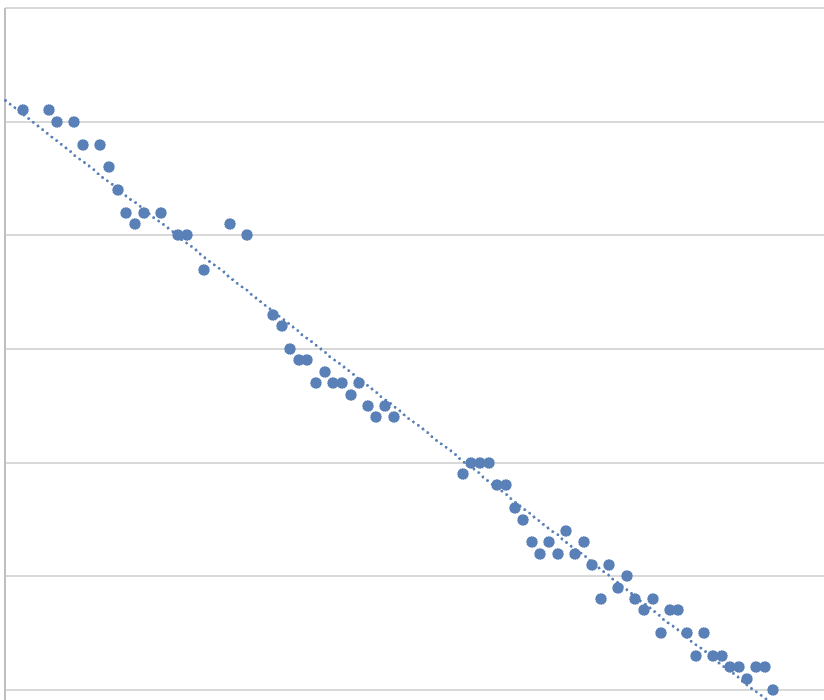
I’ve written about line dieting before; I was doing it before I knew it was a thing, in a simple Excel file, on and off as I saw fit. Somehow, even when I wasn’t dieting, I’ve kept it going for 19 years. (I’m not sure what that says about me, but I think I like it.) The spreadsheet starts in 2006 and now has 14 tabs and an extremely long view on my weight. It was a natural complement to my new focus on dietary health.
My doctor gave me a weight loss goal: 28 pounds lower than where I was before my calcium scoring test. I hadn’t weighed that little since shortly after my wedding. According to my two decades of data, I’d only even gotten within seven pounds of my goal once. I began weighing myself every morning (on the world’s most reliable scale) out of curiosity and to reliably track my progress.
On Monday, 95 days after my test, I hit my target weight.
Eating with my mother-in-law a few weeks ago, she marveled at my meticulousness. “I don’t know how you do it,” she said.
“As far as I’m concerned,” I replied, “I have no choice.”
But I did have a choice, and I chose wisely. I’ve reinvented my diet and have a clear path forward to long-term heart health.
And, of course, losing a lot of weight is fun. I can’t really gain it back, so thin me is here to stay. Which means that when our nephew gets married in September, I’ll be dusting off my own wedding tuxedo for the occasion. L’chaim!
For many years, I had a delightful clothes shopping routine: when I needed a new pair of blue jeans, I would go to Barneys Co-op and try on more or less everything in my size until I found one that met both my criteria (lays nice, all cotton, soft) and my wife’s (flat front, nice shape). I’d buy a pair—preferably on sale, because Barneys could get silly—and then immerse myself into the brand for a while, knowing I had found something that worked, and jeans are usually a repeatable purchase.
My process was quite fun, if a little hit-or-miss. I bought a fantastic pair from Citizens of Humanity, then followed up with a pair of their gray (non-denim) jeans, then discovered that Citizens stopped making 100% cotton pants in favor of elastane blends, so I stopped. Barneys once sold me an amazing pair of vintage-cut Levi’s 501s, which I wore sparingly, because I’ve never found a second pair of Levi’s that fit as well.
But when it worked, it worked. Barneys led me to Earnest Sewn, which were handsome and unbelievably comfortable, and I bought several pairs over the years. Earnest Sewn went out of business, and the founder created a new brand called 3×1; Barneys sold me my first pair of those, too, and I soon had more than one.
Then a few things happened, in rather rapid succession.
- 3×1 went out of business.* This was disappointing but fine—shopping for new jeans is fun. Except a few weeks later…
- Barneys closed. This was a long time coming, but especially sad. No more Co-op; no more Warehouse Sales; no more cutting-edge aspirational department store. And, for me especially, no more vast jeans department. Which almost immediately didn’t matter, because within weeks of that…
- The pandemic hit, and we all stopped shopping in stores for a good long while.
* Nowadays, of course, brands never die, so both Earnest Sewn and 3×1 are back on the market, with their same logos but not the same products. I’m not interested in them at that level.
By mid-2020, I was in a pants rut: my current jeans were wearing out, my preferred maker was gone, and my preferred store for finding new jeans was gone, too. I poked around online and bought a pair or two of other brands, notably one from Raleigh Denim, which I quite liked until they ripped on me within a year (customer service cited “old fabric” and declined to repair them). Not great.
So, in a fit of desperation and creativity, I started crawling the internet and accumulating 3x1s.
I kept my focus narrow. Two styles, one waist size, new or near-new only. I looked at a bunch of websites (Grailed, Poshmark) and discovered, improbably, that eBay was my best source. In all, I bought eight pairs of jeans between February 2020 and July 2023.
This process was imperfect, by which I mean all sales were final, and not all of them fit. Recall that I used to try on a zillion pairs of jeans at a time. Despite the labeling, not every pair was cut the same way; some were too tight in the waist, others too narrow for my body type. But I was also paying pennies on the dollar for old jeans, so I made my peace with the process, and hoped half of them worked out.
My family laughed at me more than once, but the process paid off more than once, too. Interestingly, the jeans I found were quite different from one another. Two pairs looked just like my old ones, and I wear them all the time. A third was extraordinarily soft, and became my go-to WFH pair, although they wore out in the knee rather quickly. Still a nice find.
And I write this blog post today because I just pulled out my greatest find: a new-with-tags selvedge denim pair, original price still stickered ($365!), which were tight when I bought them but now fit me perfectly. I’m wearing them with pride, as though I found them at the store this weekend.
At some point I am going to exhaust my collection of 3x1s. I hope by the time I do I’ll have found a new store where I can have fun trying on new jeans in person.
Last spring there was a mourning dove that decided it liked pecking at the windowsill by my desk and came by once or twice a day. I really enjoyed it. The dove was calm, unrushed, serene.
One Friday and Saturday it brought a friend, a big fat bird with nicer plumage. They looked at me through the window to make sure I was harmless. I watched them peck around and do whatever it is birds do on urban windowsills.
When the A/C is in the window, I get pigeons, which I do not like. All their cooing is distracting and not pleasant. The doves are great, though. Quiet and curious.
This morning I woke to my wife and son talking about a pigeon in the window. I smiled to myself and called out to tell them to leave it alone. Sure enough, it was one of the mourning doves—the big one, contentedly sleeping on the dining room sill, away from the street and the hubbub.
I took a picture of him when he woke up, the bird looking at me looking at it. I then went back to work and I presume the dove went about its day, too. I hope it spends more time in my windows this spring.

Somehow this marks twenty years of travelogues. As I mentioned last fall, part of longevity is just sticking to it.
One of the shortcomings of this format is that I specifically chronicle where I’ve slept, not where I’ve been. Every once in awhile this matters—like this year, where I spent eight hours in Minnesota, flying to Minneapolis early in the morning, complete with a diverted landing in Duluth, and leaving for Wisconsin before dinner. We also stayed overnight in upstate New York (listed) before driving to Vermont (not listed) for the solar eclipse in April, and spent a day in Rhode Island before crashing in the Boston suburbs. So Saratoga, Green Bay and Waltham make the log, but Minneapolis, Burlington and Providence do not. But still, I’ve been to Minnesota!
New York, NY *
Saratoga Springs, NY *
Lenox, MA *
Philadelphia, PA
Palm Beach Gardens, FL *
Green Bay, WI
Long Grove, IL
Edgartown, MA
Ann Arbor, MI *
Waltham, MA
Binghamton, NY
My 13-year-old son has been playing clarinet since fourth grade: first on a lark with friends, then more seriously, as he joined the middle school orchestra. In recent months, he really began to enjoy it, and he’s playing a lot—sometimes for two hours at a time, sometimes as late as 10 p.m. before bed.
His bedroom shares a wall with our neighbors, an older husband and wife who we don’t speak to all that much. So I was surprised when the wife stopped me on the building’s front steps a few weeks ago, as I was returning from a dog walk and she was on her way out.
“Is your son playing an instrument?” she asked. “Like a woodwind, maybe an oboe?”
In my head, I cringed, ready for a complaint. “Yes, that’s our younger son. It’s a clarinet.”
Her face brightened. “He’s getting good!”
No, I’ve never been to the World Series, and yes, I’m still annoyed about it.
Back in 1996, in the days where people would have to buy tickets in person, I waited on line at Yankee Stadium and got postseason tickets. I saw the Yanks in the Division Series, for sure; I don’t think I got ALCS tickets.
Then I waited on line again and got myself a World Series ticket. Amazing! Many of my friends had tickets with their fathers to games 1 and 2; I got myself a single seat, because my dad isn’t a big fan of baseball games, and I was not going to miss out. It was for Game 7.
The Yankees won the World Series in six games.
Thoroughly dejected, I got a refund. In the dynasty years that followed, I was unable to get a World Series ticket again, despite the Yankees’ winning three more championships by 2000. I did get to Game 6 of the 1998 ALCS, and I got to see Mariano Rivera send the Yankees to the World Series, which was incredible; I can still picture the end of the game from my seat, and the upper deck of the old Yankee Stadium bouncing in the enthusiasm. But never a World Series.
The Yankees made the postseason a lot in the ensuing years, but it occurred to me that the only thing better than seeing the ALCS clincher would be going to the World Series, so I stopped trying to get postseason tickets for the early rounds. In 2009, the only time the Yanks made the Series since 2000, I had a toddler in the house and couldn’t be bothered.
So now it’s 2024, I have two teenage sons, and Major League Baseball has a tiered, throttled system for World Series tickets, so when I tried to buy them this week, the only option available was $1266 for the wheelchair row, proof of eligibility required, and a two-ticket limit, too.
With some continued good play, the Yankees will make the 2024 World Series in the coming days, and barring some extraordinary good luck, I won’t be there, again. At least I have a story to tell.